
Table of Contents
Introduction
The AMD Radeon RX 6600 launched as a mid-range graphics card focused primarily on smooth 1080p gaming. It was designed for players who want reliable performance in modern titles without stepping into high power consumption or premium pricing territory.
Over time, it has become one of the most compared GPUs in its segment, especially against options like the RTX 3060 and the RX 6600 XT. In this review, we’ll break down how it actually performs today, where it stands against its competitors, and whether it still makes sense for a new build.
Key Specifications
| Specification | Radeon RX 6600 |
|---|---|
| Architecture | RDNA 2 (Navi 23) |
| Launch Date | October 2021 |
| Compute Units | 28 |
| Stream Processors | 1792 |
| VRAM | 8GB GDDR6 |
| Memory Bus | 128-bit |
| PCIe Interface | PCIe 4.0 x8 |
| Typical Board Power | 132W |
| Power Connector | 1× 8-pin |
Gaming Performance
Esports Titles
- This card easily exceeds 144 FPS in lighter competitive titles.
- High refresh rate 1080p monitors pair well with this GPU.
- Competitive gamers will not feel bottlenecked at this resolution.
AAA Games
- It averages 75–76 FPS in demanding AAA titles at 1080p Ultra.
- Performance remains stable above 60 FPS in most modern games.
- Ideal for high-quality 1080p gameplay without lowering settings.
Frame Time Stability
- 1% lows remain above 40 FPS in heavy AAA titles.
- Frame pacing is consistent with no major stutter spikes.
- Smoothness is strong for a mid-range 1080p GPU.
Benchmark Comparison
Overall Rasterization Performance Index
- Delivers full 1080p Ultra capability in modern titles.
- Performance ceiling aligns with mainstream gaming builds.
- Optimized more for efficiency than raw power.
Power Efficiency Comparison
- One of the most power-efficient 1080p GPUs in its class.
- Minimal PSU requirements make it upgrade-friendly.
- Strong performance-per-watt ratio.
Ray Tracing Index
- Supports ray tracing but not optimized for heavy RT workloads.
- Performance drops significantly in demanding RT titles.
- Best suited for traditional rasterized gaming.
RX 6600 Equivalent GPUs
If you want a mid-range 1080p card similar to the RX 6600, there are a few options worth comparing. Some are slightly stronger, while others are slightly weaker, but all fall near the same performance segment.
| GPU | Performance vs RX 6600 | Notes |
|---|---|---|
| NVIDIA GTX 1660 Super | Slightly below | Older, weaker in new games |
| AMD RX 580 | Slightly below | Good 1080p, uses more power |
| AMD RX 590 | Slightly below | Runs hotter than RX 6600 |
| AMD RX 6400 | Slightly below | Lower performance, very efficient |
| NVIDIA RTX 3060 | Slightly above | Better in modern titles |
| AMD RX 5700 XT | Slightly above | Faster, higher power draw |
| AMD RX 6650 XT | Above | 10–20% faster, next tier |
RX 6600 vs RX 6600 XT
The RX 6600 XT is the stronger version of the RX 6600. It offers more compute units and higher clock speeds, resulting in roughly 10–15% better gaming performance.
| Specification | RX 6600 | RX 6600 XT |
|---|---|---|
| Compute Units | 28 | 32 |
| Stream Processors | 1792 | 2048 |
| Boost Clock | Up to 2491 MHz | Up to 2589 MHz |
| VRAM | 8GB | 8GB |
| Typical Board Power | 132W | 160W |
In practical terms, the difference is noticeable but not dramatic. The final choice usually depends on pricing and how much extra performance you are willing to pay for.
Power Consumption & Thermals
Efficiency is one of the RX 6600’s biggest strengths. With around 130W of power usage during gaming, it runs cooler and quieter than many older mid-range GPUs.
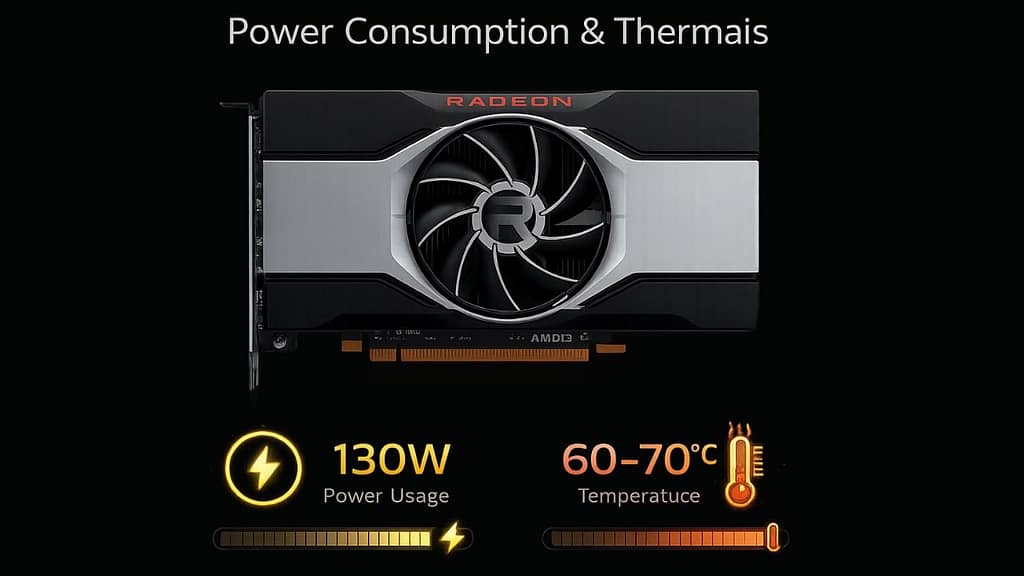
Temperatures usually stay within the safe 60–70°C range with proper airflow. A quality 450W power supply is typically enough.
Note: For users upgrading from cards like the GTX 1060 or RX 580, the efficiency improvement is significant.
Drivers, Features & Software
This card uses AMD’s Adrenalin software. Driver stability has improved over the years and is generally reliable.
Features like FSR can boost performance in supported titles, and Smart Access Memory can provide small gains when paired with compatible AMD CPUs.
Ray tracing exists, but this card performs best in traditional rasterized gaming.
Who Should Buy the RX 6600?
Buy if:
- You want smooth 1080p gaming.
- Don’t prioritize heavy ray tracing.
- Have a modest PSU (450–550W).
- Upgrading from older mid-range GPUs.
- Price is reasonable compared to stronger alternatives.
Avoid if:
- Planning 1440p Ultra or higher.
- Ray tracing matters.
- Looking for long-term future-proofing.
- A slightly stronger GPU is available at a similar price.
Final Verdict
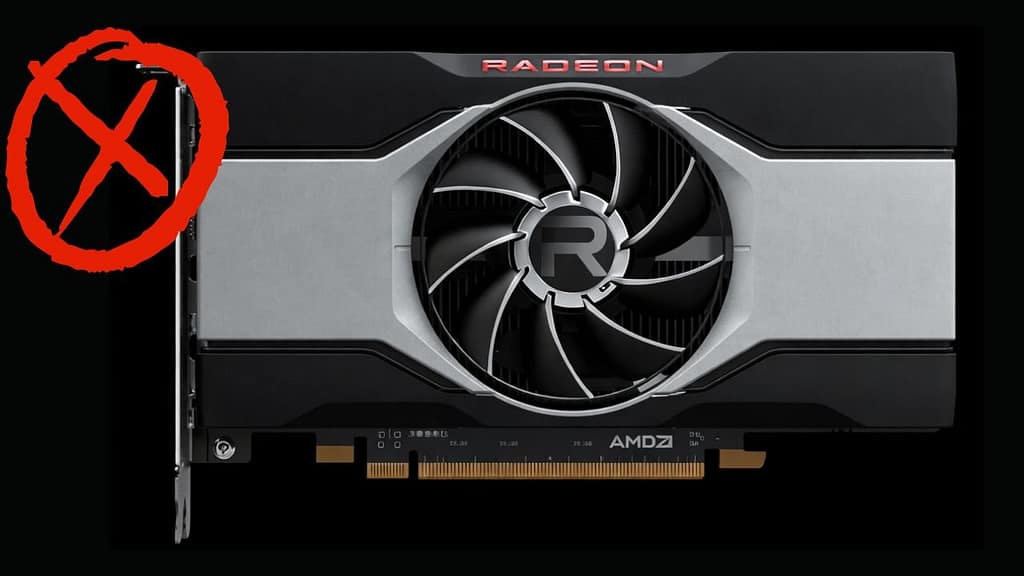
The RX 6600 is a solid 1080p graphics card in 2026. It delivers smooth gameplay in modern AAA titles, easily handles esports games at high refresh rates, and stays cool while drawing only 132W.
It isn’t a powerhouse, ray tracing performance is weak, and it isn’t built for 1440p Ultra or future-proofing. But for gamers who want reliable performance without overspending, it’s an efficient, practical choice.
In Short
If priced right, the RX this card remains one of the best mid-range 1080p options. Overpriced? Step up to a stronger card or wait for deals.
