
Table of Contents
GTX 1650 vs 1650 Super
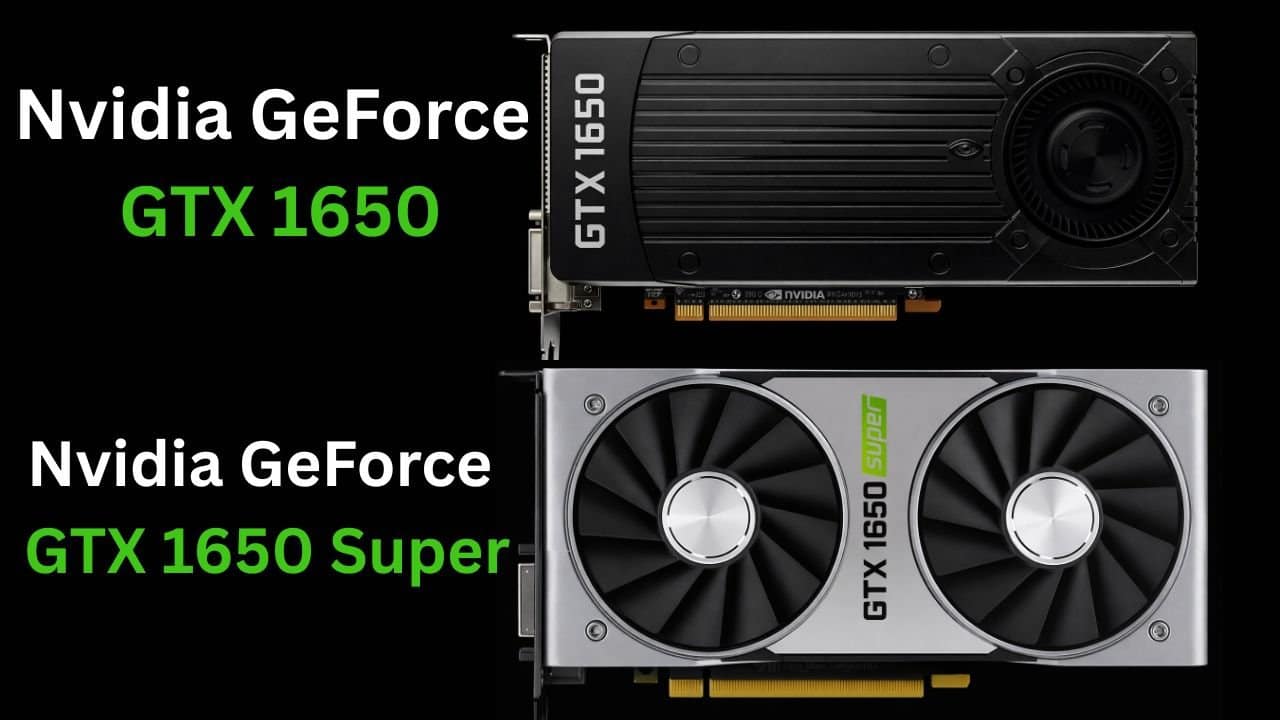
Choosing between the GTX 1650 vs GTX 1650 Super can be confusing, especially in 2026 when both cards mostly exist on the used market. On paper, they look similar. Same generation. Same 4GB VRAM. Same 128-bit memory bus.
But in real use, they don’t feel the same and that difference matters when you’re spending your own money.
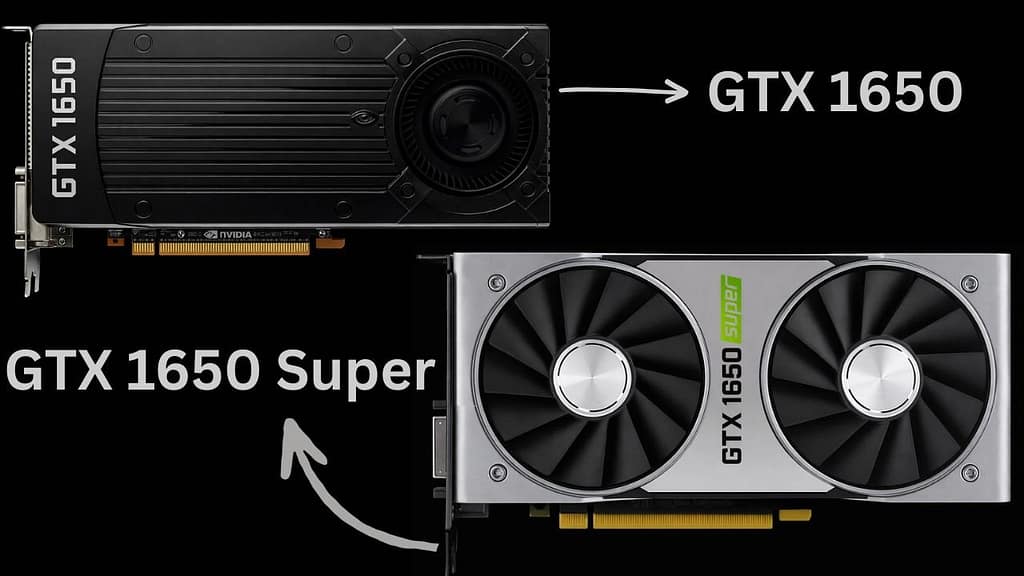
Key Differences: GTX 1650 vs GTX 1650 Super
| Feature | GTX 1650 | GTX 1650 Super |
|---|---|---|
| Architecture | Turing | Turing |
| CUDA Cores | 896 | 1280 |
| Memory | 4GB GDDR5 | 4GB GDDR6 |
| Memory Bus | 128-bit | 128-bit |
| Power Draw | 75W | 100W |
| Power Connector | Mostly not required | 1x 6-pin |
What this actually means
- The GTX 1650 Super has significantly more CUDA cores, which directly translates to higher FPS.
- GDDR6 memory on the Super helps with smoother frame pacing, especially in newer games.
- The power connector is a real difference, not a small detail. The GTX 1650 fits into more older PCs without PSU upgrades.
VRAM Limitations
Both cards come with 4GB VRAM, and this matters more than people think.
What happens in real use:
- New AAA games often exceed 4GB at high settings
- When VRAM fills up:
- Texture pop-in appears
- Stutters increase
- FPS drops suddenly, even if average FPS looks fine
GTX 1650 Super handles this slightly better due to faster GDDR6 memory,
but 4GB is still 4GB, no magic here. Texture quality will often need to be set to Medium, even at 1080p.
Note: This doesn’t mean games are unplayable, it just means settings need to be adjusted smartly.
1080p Gaming Performance
When people search for GTX 1650 vs GTX 1650 Super, what they really want to know is how these cards actually perform in real games.
In real-world gaming, the GTX 1650 vs GTX 1650 Super difference becomes most visible at 1080p, which is exactly the resolution these cards are designed for.
Average FPS vs Minimum FPS
Most people only look at average FPS numbers, but that doesn’t tell the full story.
Average FPS shows how fast a game runs overall, while minimum FPS shows how smooth it feels during heavy scenes.
Sometimes both cards show similar FPS numbers in charts.
But when the game becomes heavy, like during fights or explosions, the GTX 1650 Super keeps the FPS more stable.
This means fewer sudden FPS drops, less lag, and smoother gameplay compared to the normal GTX 1650.
Streaming, Recording & NVENC
Both GTX 1650 and GTX 1650 Super use Nvidia’s older NVENC encoder, so there’s no real difference between them for streaming or recording.
| What they handle fine | Where They Struggle |
|---|---|
| Casual game recording | High-quality YouTube production |
| Light streaming at 720p or 1080p | Professional streaming setups |
| Basic screen capture | Gaming + heavy multitasking at the same time |
You can stream or record on these GPUs, but once the game gets heavy, quality drops or performance takes a hit.
Straight truth: These are gaming GPUs first. Content creation is a bonus, not their strength.
Driver Support & Future Compatibility
Both GTX 1650 and GTX 1650 Super use Nvidia’s Turing architecture, so driver support is basically the same for both.
What to expect:
- New games will still run
- Nvidia will continue basic driver updates
- No ray tracing or DLSS support
What not to expect:
- Performance boosts from future drivers
- Special optimizations for new AAA games
In simple terms, these GPUs are supported, but not a priority anymore.
If a new game launches with poor optimization, lowering settings is often the only fix.
This applies equally to both cards, neither is more future-proof than the other.
Power Consumption & System Compatibility
When comparing GTX 1650 vs GTX 1650 Super, power requirements are one of the most important differences that can completely change the buying decision.
| GTX 1650 | GTX 1650 Super |
|---|---|
| Very low power usage | Higher power draw |
| Most models don’t need a power connector | Requires a 6-pin connector |
| Perfect for older PCs and office prebuilts | Needs a decent PSU (not high-wattage, but good quality) |
| True drop-in upgrade |
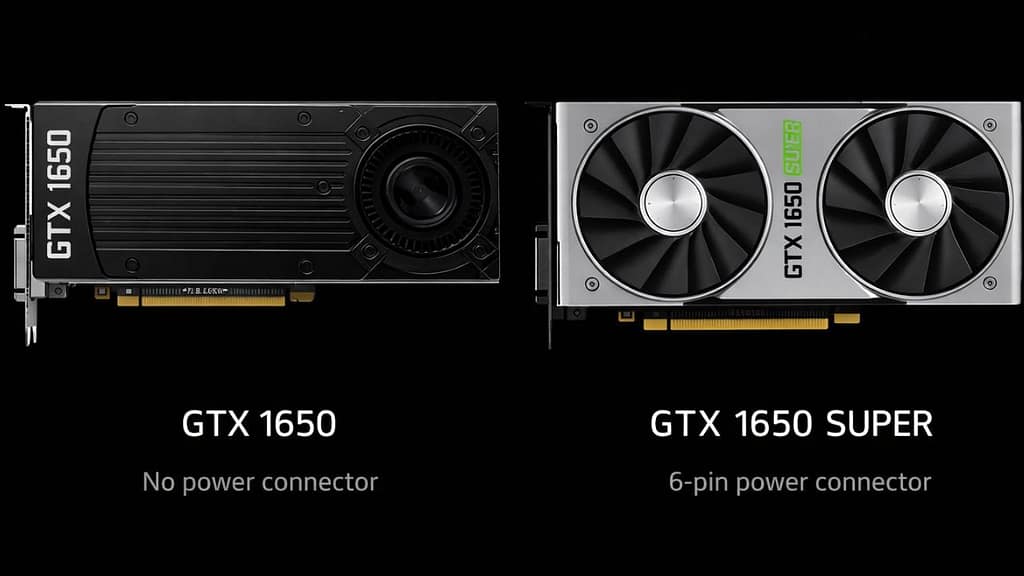
Note: The GTX 1650 Super is faster, but it is not plug-and-play for every system.
If you’re upgrading from very old GPUs like the GTX 660 or GTX 650 Ti Boost, the GTX 1650 often makes more sense because of its low power requirements.
Thermals & Noise
- GTX 1650 generally runs cooler
- GTX 1650 Super runs slightly hotter due to higher power draw
Cooling quality matters more on the Super:
- Single-fan models can get louder
- Dual-fan cards stay quieter and more stable
Note: With basic case airflow, neither card has serious overheating issues.
Knowing what temperatures are normal is important, especially when buying used. If you’re unsure, our guide on average GPU temperature explains what’s safe and what’s not.
Resale Value & Market Stability
Let’s be honest, many buyers think about resale, even if they don’t say it.
- GTX 1650 Super usually holds value better because of higher performance
- GTX 1650 often sells faster since it works in more systems without PSU upgrades
One real risk people often ignore:
Cheap single-fan 1650 Super models tend to age worse. They run hotter, get louder over time, and are more likely to feel “used.”
Simple buying rule:
- A clean dual-fan 1650 Super is a better buy than a noisy, abused one, even if it costs a bit more.
- Condition matters more than small price differences in the used market.
Used Market Reality (2026)
Let’s be honest, most buyers in 2026 are looking at used GPUs.
Good news:
- These cards were not heavily used for mining
- Many used units are still in decent condition
What to check before buying
- Clean physical condition
- Fans spin smoothly
- Temps stay under 75°C under load
- No screen flicker or crashes
- Running a proper GPU stress test helps confirm stability and cooling performance.
If the seller doesn’t allow testing, walk away.
Note: If you find a clean, tested card at the right price, buying used here is generally safe.
Price-to-Performance Rule
Use this simple rule to avoid regret:
- If GTX 1650 Super is 10–15% more expensive → buy the Super
- If GTX 1650 Super is 30%+ more expensive → GTX 1650 makes more sense
If the GTX 1660 or 1660 Super is priced close, it’s often smarter to skip both 1650 cards entirely.
Note: Also consider PSU upgrade cost, it can flip the decision.
Hidden Cost Nobody Talks About: PSU Upgrade
This is where many buyers mess up.
| GTX 1650 | GTX 1650 Super |
|---|---|
| No PSU cost | Possible PSU upgrade |
| No cable issues | Cable compatibility issues |
| No stress | Extra cost that kills “value” |
Note: If PSU upgrade is needed, price-to-performance math breaks.
Who Should Buy Which GPU
Buy GTX 1650 if:
- You want the cheapest, safest upgrade
- You have an older PC or prebuilt system
- Your PSU doesn’t support a 6-pin connector
- You mainly play esports titles
Buy GTX 1650 Super if:
- Your PSU supports it
- You play modern games at 1080p
- You care about smoother gameplay
- You want better longevity within limits
Who Should Avoid Both
These GPUs are not for you if:
- You want 1440p or 4K gaming
- You expect ultra settings in new AAA titles
- You plan heavy streaming or video editing
Warning: They’re entry-level cards. Expecting more will only lead to frustration.
Final Verdict
Looking at everything side by side, the GTX 1650 vs GTX 1650 Super comparison is less about raw numbers and more about system compatibility and expectations.
The GTX 1650 Super is objectively the better GPU.
It delivers higher FPS, more stable performance, and a noticeably smoother gaming experience in modern 1080p titles.
But the GTX 1650 still has a place, not because it’s powerful, but because it’s easy to live with.
In the end, this isn’t a benchmark decision.
It’s about what your system can realistically handle and what kind of experience you expect from it.
- If your PSU supports it, the GTX 1650 Super is the better long-term choice.
- If you’re unsure about power or system limits, the GTX 1650 remains the safer option with fewer regrets.
For readers still comparing multiple options, our GTX 1660 vs GTX 1660 Super comparison may help finalize the decision.
