
Table of Contents
Introduction
The GTX 650 Ti Boost is one of those mid range cards that refuses to die. It launched more than a decade ago, yet somehow it still pops up in budget builds and dusty office PCs that someone decides to turn into a “gaming rig.” And honestly, there’s a simple reason for that: this card was built during a time when mid range GPUs actually had some punch.
Specifications
| Feature | Details |
|---|---|
| Architecture | Kepler |
| CUDA Cores | 768 |
| Base Clock | 980 MHz |
| Boost Clock | 1033 MHz |
| Memory | 2GB GDDR5 |
| Memory Bus | 192-bit |
| TDP | 134W |
| Recommended PSU | 450W |
| Power Connector | 1×6-pin |
| Launch Year | 2013 |
GTX 650 Ti Boost Release
When Nvidia launched the GTX 650 Ti Boost in 2013, it filled the gap between the GTX 650 Ti and GTX 660, making it a perfect mid range choice for 1080p gaming. It wasn’t a flagship, but it consistently punching above its price, quickly earning popularity among budget gamers.
Today, its old competitors are long gone, replaced by far more powerful GPUs, yet the 650 Ti Boost still remains a cheap, “good enough” option for ultra budget builds.
Design & Build Quality
The GTX 650 Ti Boost features a classic early-2010s Nvidia design, a simple shroud, single fan, and a PCB that just gets the job done without trying to impress. Even after all these years, its cooling system performs better than expected, keeping temperatures under control as long as your case airflow isn’t terrible.
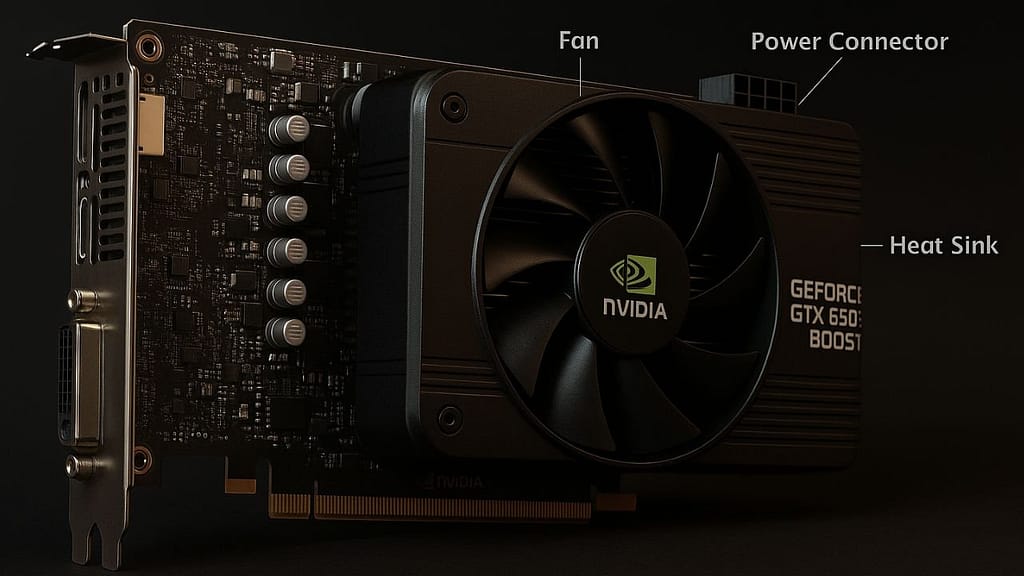
Noise is moderate, nothing extreme. The card does get warm, but it rarely reaches dangerous levels. Throttling only happens if the card has already been heavily used or abused.
Gaming Performance in 2025
Overclocking Potential
The GTX 650 Ti Boost can actually be pushed a bit if you want a little more FPS. Most cards can hit around 1050–1070 MHz on the core, memory goes a bit higher, and usually it doesn’t crash. In games like CS:GO, Dota 2, or LoL (League of Legends), that’s like 5–10% extra FPS, which you can definitely notice.
GPU temperatures can climb though, since it’s a single fan cooler. If you’re running it for a long session, keep an eye on that. A little voltage tweak or better airflow in your case helps. But honestly, even just a +50 MHz core bump is safe and enough for most setups.
Driver Support & OS Compatibility
The last official Game Ready driver for Kepler GPUs was released some time ago, and Nvidia no longer provides fresh updates. The good news? The GTX 650 Ti Boost still works perfectly on Windows 10 and runs decently on Windows 11 using compatible drivers.
Linux support is even better, thanks to the open-source community keeping older GPUs alive and functional.
Thermals & Power
Even after all these years, the GTX 650 Ti Boost handles heat like a champ, with most units staying around 65°C–72°C under gaming load, which is normal for a 2013 GPU.
Its power consumption is 134W, higher than modern GPUs but standard for its time. As long as your PSU is decent, the card runs fine. Undervolting can help in cramped setups, but it’s optional for most builds.
650 Ti Boost 2GB vs 4GB Models
The 2GB model is the biggest weakness today, as many modern games require at least 4GB to load textures properly. If you have the 4GB version, you can get a bit more life out of the card, but it doesn’t turn it into a modern performer.
VRAM is the wall you keep hitting, and no amount of tweaking can fully overcome this limitation.
Used GTX 650 Ti Boost Prices
The GTX 650 Ti Boost usually sells for $20–$30 in the used market, depending on condition. Anything above that, and you’re likely overpaying.
Honestly, this GPU only makes sense for ultra cheap builds, retro gaming PCs, or basic esports setups. If your budget allows even a little more, cards like the GTX 960, GTX 970, or RX 570 deliver exponentially better performance.
Pros & Cons
| Pros | Cons |
|---|---|
| Solid performance in older and esports titles | 2GB VRAM is a major bottleneck |
| Cheap on the used market | No modern driver updates |
| Good thermals despite age | Cannot handle modern AAA games |
| Runs well on Linux | Higher power draw than newer entry-level GPUs |
| Low cost upgrade for old office PCs |
Should You Buy It in 2025?
Look, if all you care about is old games, esports stuff, or a retro gaming rig, the GTX 650 Ti Boost still does the job. It’ll run most 1080p titles fine, and at its price, it’s hard to beat for a cheap build or a second PC.
But if you’re thinking about modern AAA games or heavy workloads, forget it, this card just can’t keep up. Even the 4GB model won’t save you, and you’ll hit VRAM and performance limits fast.
In Short:
the GTX 650 Ti Boost is still alive, but it’s now firmly a “budget survival” GPU. Perfect for light gaming or retro setups, but if you want anything modern, spend a bit more and grab a newer card.
