
Introduction
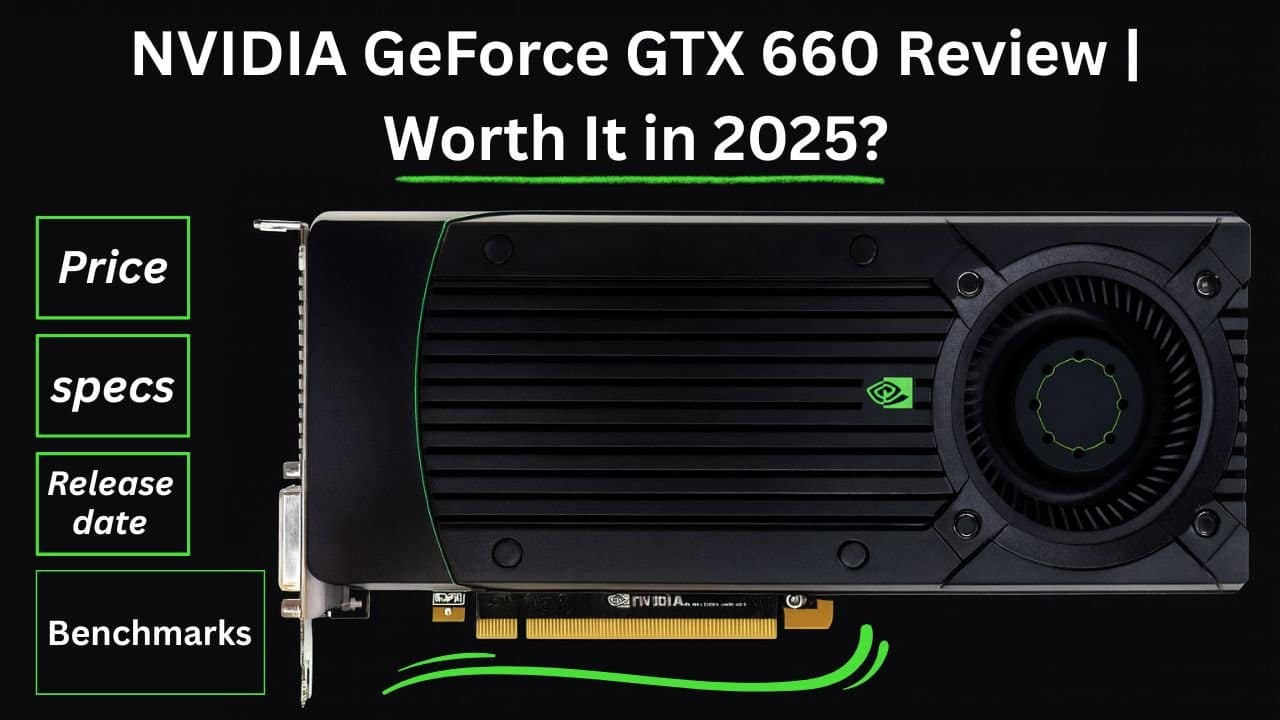
The GTX 660 had its moment years ago when it landed right in that sweet mid range spot for 1080p players. It wasn’t a beast, but it didn’t need to be, especially for folks who were just learning what a GPU actually is. It just got the job done without burning your wallet. Fast forward more than a decade, and people are still asking the same thing: is this old timer still useful, or should it finally be laid to rest?
Specifications
| Specification | Details |
|---|---|
| CUDA Cores | 960 |
| Base Clock | 980 MHz |
| Boost Clock | 1030+ MHz |
| Texture Units | 80 |
| ROPs | 24 |
| Die Size | 221 mm² |
| Transistors | 2.5 billion |
| Interface | PCIe 3.0 |
| Power Connector | 1 × 6 pin |
| TDP | 140 W |
GTX 660 Release Date
The GTX 660 hit the market on September 6, 2012. Back then, NVIDIA wanted a card that wasn’t too cheap, not too fancy, something right in the middle. It sat above the GTX 650 but below the 660 Ti. Its main rival? AMD’s Radeon HD 7850.
People liked it because it gave decent performance without costing a ton. And honestly, some of these cards are still kicking around in older prebuilt PCs, which says a lot about how well they were made.
Architecture and Design
The GTX 660 is built on NVIDIA’s Kepler architecture, with the GK106 GPU running on a 28 nm process. Back in the day, it was all about squeezing good performance while keeping power use low, pretty handy in the early 2010s.
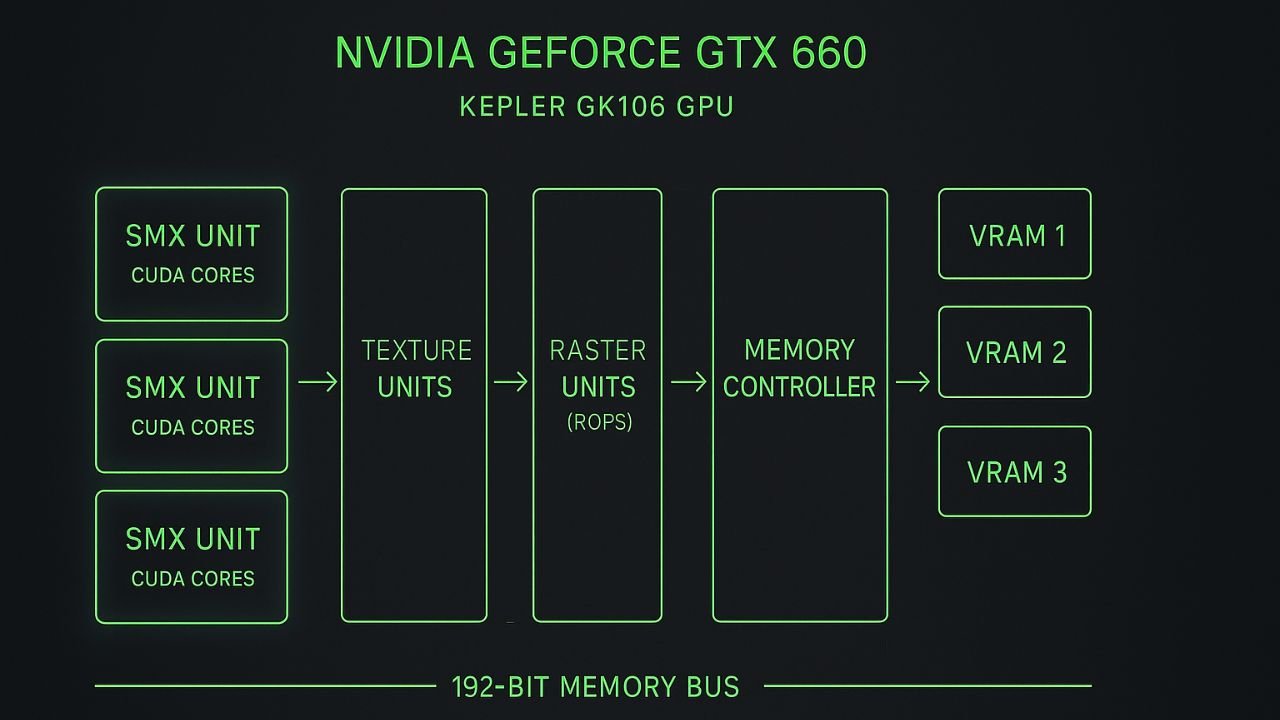
It had cool things like GPU Boost and better compute performance, but honestly, compared to today’s Turing, Ampere, or Ada Lovelace cards, it feels really old. Kepler was neat back then, but modern games don’t really cut it for this old design.
VRAM and Memory Bandwidth
The GTX 660 has 2 GB of GDDR5 VRAM on a 192 bit memory bus. Back when it launched, that was totally fine for 1080p gaming, no complaints.
Now? That 2 GB is basically the card’s biggest weakness. Modern games eat up memory like crazy, especially with high-res textures. Sometimes even lighter games hiccup because the card runs out of VRAM and starts using system memory, and yeah, that causes stuttering.
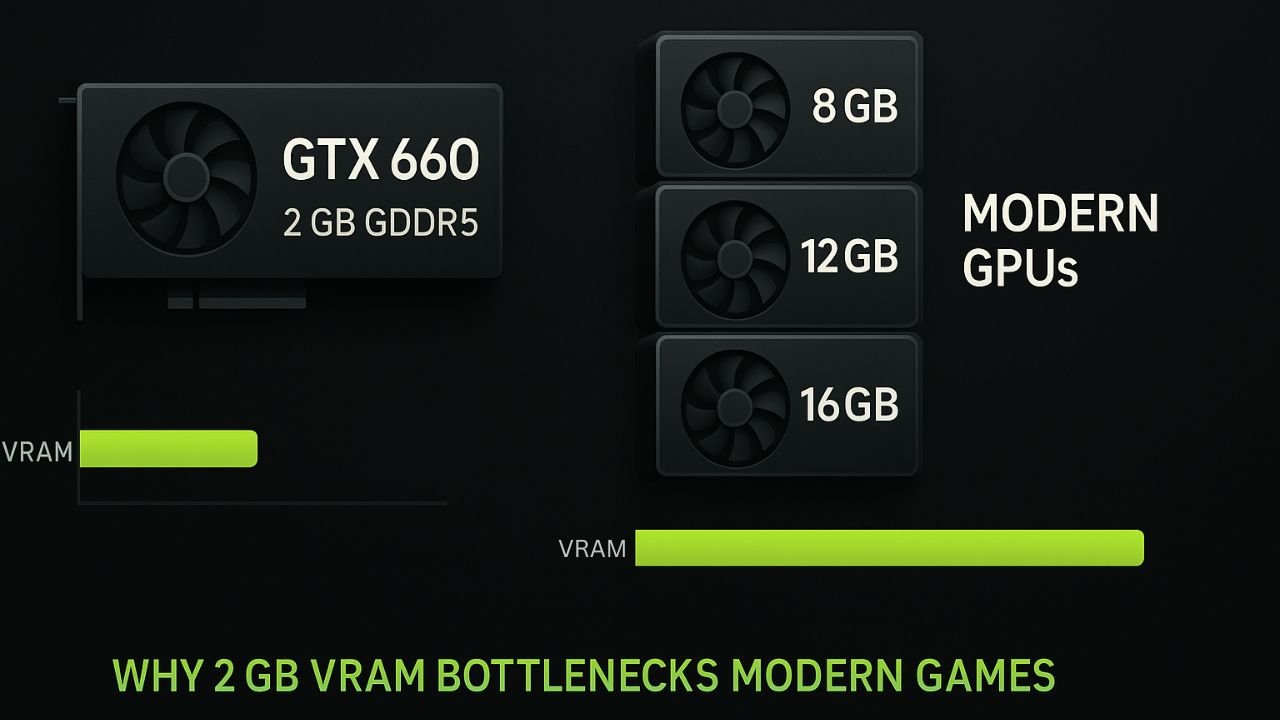
Memory bandwidth is around 144 GB/s, which was decent back in 2012. But honestly, compared to today’s GPUs, it feels tiny, like really tiny.
Driver Support and Software
When the GTX 660 first came out, it actually got solid driver updates from NVIDIA. It had the usual features from that time, PhysX, CUDA, GPU Boost, all the stuff gamers expected back then.
But in 2025, things look completely different. Kepler cards don’t really get real performance updates anymore. Most of the new driver improvements are aimed at newer architectures, and half of the modern features just don’t work on this card at all.
DLSS isn’t supported, obviously. FSR can run in a few games, but the card is usually too weak to get anything useful out of it anyway. At this point, the drivers aren’t improving performance they’re basically just keeping the card alive so it doesn’t break anything.
GTX 660 Prime Benchmarks
Gaming Performance in 2025
Let’s be real, in 2025, this card is way out of its depth with modern AAA games. The low VRAM hits first, and the old architecture doesn’t help either. Even after killing the settings and dropping everything to low, a lot of new titles still hitch or dip hard when things get busy. It’s playable in the same way limping is still technically “walking.”
The story flips a bit with older stuff. Anything from the late 2000s to mid-2010s runs surprisingly well, and the GTX 660 doesn’t throw a fit there. Esports titles are also fine, CS:GO, LOL, Dota 2, all of them run comfortably as long as you don’t push silly settings.
Indie games and lightweight single player titles? No problem. But once you move to the heavy modern releases, the card just taps out. Time has caught up to it, and no amount of tweaking is going to change that.
Thermals and Power Consumption
For its age, the GTX 660 actually holds up fine in the temperature department. but if you really want to see how it behaves under heavy load, you should stress test your GPU. Most models sit somewhere in the mid-60s to mid-70s under load, and that’s with decade old cooling designs. Nothing scary, nothing thermal throttling unless the card is dusty or abused.
Power draw is where the age starts to show. Around 140W isn’t insane, but the performance you get for that wattage is rough by today’s standards. Modern entry level GPUs pull the same or even less power while absolutely destroying the 660 in real world performance. Basically, it runs cool enough, but it’s not efficient anymore.
Noise Levels
Most GTX 660s use older dual fan designs, and yeah, they get a bit loud once you push them. The fans have to work harder because the hardware is a decade old, and the thermal paste on many of these cards is probably way past its prime.
A fresh repaste and a proper fan clean up can bring the noise down a little, but don’t expect quiet operation. These cards were never silent, and age hasn’t helped them.
Pricing in 2025
The GTX 660 basically has no real value today. You’ll mostly see it in scrap PCs or random ultra cheap listings, and honestly, paying more than a few dollars for one is a waste in 2025.
Even the lowest-tier modern budget GPUs completely wipe the floor with it — they’re faster, cooler, and far more power-efficient. At this point, the 660 is more of a spare-parts card than a serious option.
GTX 660 Pros & Cons
| Pros | Cons |
|---|---|
| Runs older games smoothly | Only 2 GB VRAM |
| Low power requirements | Very outdated Kepler architecture |
| Easy driver installation | No real support for modern games |
| Extremely cheap in old builds | Struggles with most 2023–2025 titles |
| Driver support is minimal now | |
| Weak performance per watt vs modern GPUs |
What We Think
The GTX 660 had a great run. When it launched, it was the go-to mid range card for anyone who wanted solid 1080p gaming without spending crazy money. It did its job well for years.
But let’s be real, in 2025, it’s basically a relic. It’s fine for older titles, older esports games, or if you’re messing around with retro stuff. Anything newer, anything heavy, or anything that needs more than 2 GB VRAM, the card just taps out. No amount of tweaking is going to turn it into something it’s not.
If you’re upgrading a system today, even the cheapest modern GPUs will smoke the 660 in every way, performance, power draw, drivers, features, everything. The 660 was solid for its time, but that time has passed.
